Roblox is not one game. It is a constantly changing platform of experiences, creators, economies, communities, and live player populations. Someone looking for a new game may want to know what is growing today. A returning player may need the latest working code. A trader may be comparing two inventories, while a developer may be watching whether an update changed the size of an audience.
Those questions usually lead to different websites—and often to numbers with no source, no timestamp, or no explanation of how they were calculated.
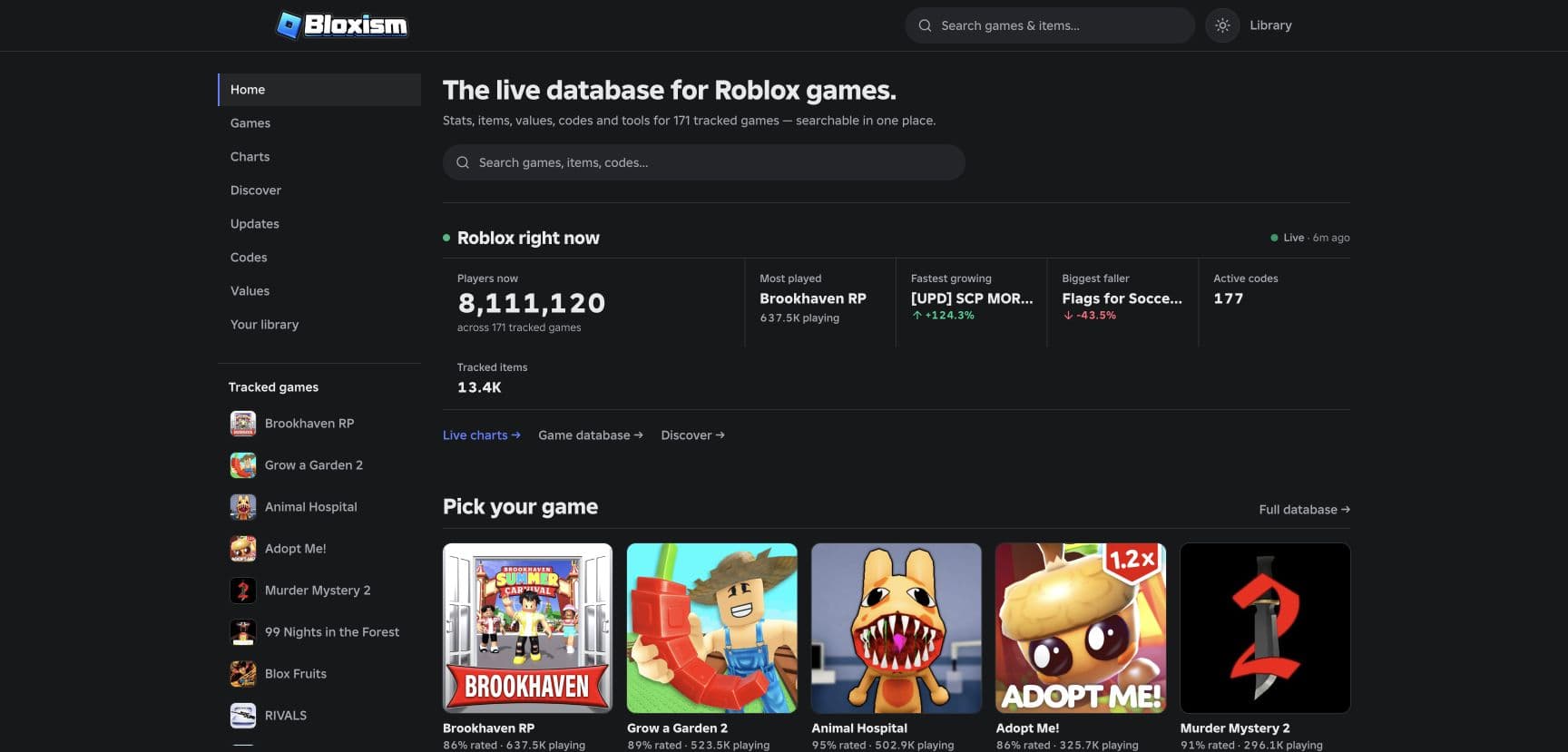
That fragmentation became the starting point for Bloxism, a live Roblox analytics and game database. We built it to connect real-time player data, historical trends, game wikis, working codes, item values, updates, creator records, comparisons, and practical tools in one searchable product.
The challenge was larger than collecting Roblox data. Bloxism needed a shared model that could track hundreds of games consistently, while still giving deeply documented titles their own items, mechanics, guides, codes, values, and tools. It also needed to distinguish live measurements from editorial knowledge so users could understand where every answer came from.
Concurrent players, movement, ratings, peaks, visits, favorites, records, and timestamped snapshots.
Items, pets, houses, vehicles, skills, updates, guides, codes, values, and game-specific systems.
Source, verification date, confidence, formula version, and honest treatment of missing history.
Trade checks, inventory totals, stock tracking, calculators, personal watchlists, and Discord commands.
The problem: Roblox discovery has a context gap
A raw player count can tell someone which game is large, but not whether it is growing, falling, stable, well rated, recently updated, or simply experiencing a temporary spike. An item value without its game-specific unit can look precise while being meaningless. A code list without a verification time may waste more time than it saves.
The platform also contains radically different products. Brookhaven RP is organized around houses, vehicles, locations, props, and roleplay. Adopt Me! has pets, trade values, demand, inventories, and win-or-lose trade decisions. Blox Fruits has codes, fruits, progression, and combat systems. Grow a Garden adds seeds, stock cycles, mutations, recipes, and planning tools.
Flattening every game into the same generic wiki template would remove the information that makes each one useful. Building every section as a disconnected microsite would duplicate analytics, search, navigation, and data infrastructure.
We designed Bloxism around a layered answer: measure every tracked game consistently, then add game-specific depth where the player needs it.
| Product layer | The immediate question | Context Bloxism preserves |
|---|---|---|
| Live analytics | What is happening now? | Timestamp, current players, movement, peaks, rating, and history |
| Game database | What does this game contain? | Game-specific entities, mechanics, relationships, and guides |
| Codes and updates | What changed or became available? | Verification state, source, reward, expiration, and publish time |
| Values and tools | Is this trade or inventory worth it? | Per-game units, demand, source, verification date, and uncertainty |
| Discovery | What should I play next? | Genre, play style, momentum, depth of coverage, and comparisons |
Turning public Roblox data into historical analytics
The Roblox game database is the shared measurement layer. At the time of this case study, Bloxism tracks 171 games and captures concurrent players, visits, favorites, ratings, update times, and other public signals on a recurring sync schedule.
Roblox’s public APIs provide the current observation. Bloxism adds the historical layer. Every snapshot is timestamped and stored rather than overwriting the previous number, allowing the product to calculate:
- 24-hour and 7-day movement
- Recorded peaks
- Growth and decline
- Volatility and stability
- Rank changes
- Time-of-day patterns
- Longer-term player-count charts
Games that span multiple Roblox places require another normalization step. Their concurrent players must be aggregated into one experience-level record before that game can be compared responsibly with the rest of the catalogue.
Each deeply covered title has a dedicated analytics surface. The Brookhaven RP player-count page, for example, combines the current population with a historical chart, recorded peaks, recent observations, update timing, volatility, and a downloadable CSV. It can answer a quick “How many people are playing?” question while still supporting deeper research.
Charts that separate size from momentum
One leaderboard cannot explain an ecosystem as active as Roblox. The largest game right now is not automatically the fastest growing, the best rated, the newest breakout, or the title setting a new record.
The live Roblox charts divide those questions into focused rankings:
- Most played
- Trending
- Fastest growing
- Biggest fallers
- Highest rated
- Most visited and most favorited
- Breakout games
- Recently updated and newest games
- 24-hour peaks, records, and weekly winners
That separation is important. “Most played” ranks the current audience. “Fastest growing” measures percentage movement. “Trending” balances momentum with a popularity factor so a tiny game cannot top the platform by doubling from an extremely small baseline.
The interface keeps the ranking rule close to the result. Users can see whether a board reflects absolute players, percentage change, approval, reach, or a composite measure instead of assuming every chart is another popularity list.
Building a score without hiding the formula
We created the Bloxism Score as a compact way to summarize how a game is performing now. The 0–100 score combines four measurable components:
- Popularity
- Player approval
- Recent growth
- Stability
The score is not presented as an official Roblox metric, and it does not claim access to private retention or revenue data. Each component is normalized, weighted, and documented. The methodology page publishes the current formula version and explains why a score may move.
History-dependent inputs create an important edge case. A newly tracked game may not have enough observations to calculate growth or stability responsibly. Bloxism uses a neutral input for those components, lowers the confidence label, and marks the score accordingly rather than inventing a trend.
That pattern extends throughout the Bloxism methodology: define what a metric means, show where the inputs come from, explain the minimum history required, and make uncertainty visible.
One platform, two depths of game coverage
Bloxism uses the same core record for every tracked Roblox experience, but it supports two different levels of coverage.
Automatically tracked games receive a focused page with live players, history, rating, creator, update information, Roblox links, and the shared analytics model. This gives a newly discovered or fast-growing game a useful, crawlable home without waiting for a full editorial buildout.
Deeply covered games add a purpose-built wiki and toolset on top of that foundation. The Brookhaven RP database, for example, organizes:
- Houses
- Vehicles
- Locations
- More than 400 props
- Gamepasses
- Updates
- Guides and frequently asked questions
That structure would not make sense for a trading game or an RPG. Each deep game can introduce its own entity types and navigation while still inheriting the same analytics, search, creator, discovery, and update infrastructure.
This was one of the most important product decisions behind Bloxism. The platform can expand breadth automatically while investing in depth where a game’s audience and information needs justify it.
Codes treated as changing data, not copied text
Roblox codes expire, appear after updates, and are frequently copied across the web long after they stop working. A useful codes product needs more than a page full of strings.
The Roblox codes database groups every supported game, shows the number of active codes, and gives each title a dedicated destination. Individual pages such as the Blox Fruits codes list separate working and expired codes, identify the reward, show when the source was last checked, and make redemption a one-tap copy action.
Code changes also enter the platform’s Roblox updates feed. This lets someone discover a newly verified code from the current activity stream and then move into the complete game-specific list without creating two unrelated content systems.
The editorial rule is simple: if a code has not been verified, the interface should not describe it with the same certainty as one that has.
Value lists that respect separate game economies
Bloxism tracks more than 13,000 items across its supported databases, but an item value means something different in every game. Adopt Me! reference points cannot be compared with Blox Fruits values or a Murder Mystery 2 scale.
The Roblox item values hub preserves that context. Every game has its own unit, source, methodology, and verification date. The Adopt Me! value list, for example, states what its reference points mean, identifies the source behind the scale, and links every pet to a detailed record.
Historical value tracking is stored as observations, just like player analytics. A comparison appears only after enough verified history exists. Until then, Bloxism says that the window is incomplete rather than implying movement from a single measurement.
This makes the values layer useful for decisions without pretending community economies are official or perfectly stable.
Tools built directly on the databases
The Bloxism tools collection turns the same underlying records into practical workflows.
The trade calculator compares what a player gives and receives, then produces a win, fair, or lose verdict using the current game-specific value scale. The inventory calculator searches the same database, totals a collection, and keeps the value date visible. Stock tracking adds a live operational layer for shops and restock cycles.
General utilities such as odds, time-to-kill, and farming-return calculators accept player inputs, while game-specific tools are connected directly to curated items and values.
Because the calculators use the same records as the database pages, a value correction or newly documented item can flow through the entire product instead of being updated independently in several tools.
Discovery by genre, play style, creator, and comparison
Roblox discovery often defaults to a popularity feed. Bloxism adds several different ways to move through the catalogue.
The game discovery guide organizes titles by genre and by the way someone wants to play: competitive, relaxing, social, trading-focused, grind-focused, creative, horror, survival, and more. Coverage labels distinguish a deeply documented game from one that currently has analytics only.
Creator pages connect studios and developers to their games and aggregate the audience across those titles. The Roblox creator directory therefore answers a different question from a game leaderboard: which teams are responsible for the audiences players are seeing?
The game comparison tool puts two compatible titles side by side using live player counts, ratings, reach, growth, and Bloxism Scores. It frames popularity as a measurement rather than a quality verdict and leaves history-dependent fields blank until the data exists.
Global search ties those paths together. A player can search games, items, and codes from the same interface rather than learning a separate search pattern for every database.
A personal library without an account requirement
Favorites, watchlists, and recently viewed pages are useful long before someone wants to create an account. Bloxism stores those features in a local personal library, keeping the experience fast and private on the player’s device.
That reduces friction for ordinary users while leaving room for workflows that genuinely require identity, such as a developer claiming a game record.
Bloxism also brings its public data outside the website through the Bloxism Discord bot. Slash commands can return live player counts, trending games, active codes, and values inside a community server. The bot reads the same public platform rather than maintaining a second, drifting set of answers.
Combining automation with reviewed editorial coverage
Not every update deserves an invented story, and not every automated change is ready for editorial interpretation.
Bloxism separates its updates into reviewed coverage and a plain activity log. Verified stories can explain an update, event, patch, or group of codes against a source. Automatically observed changes remain factual entries until there is enough information to say more.
That distinction protects the platform from a common failure mode in large content databases: generating confident prose to fill every gap. Automation is used to detect and organize changes. Editorial review is used when explanation and judgment are required.
Search architecture for hundreds of games and thousands of items
Bloxism’s information architecture creates stable routes for games, analytics, codes, values, creators, genres, comparisons, items, tools, and guides. Important information is not hidden behind one client-side dashboard or a single search result screen.
A game hub can lead to its analytics, wiki categories, codes, values, creator, guides, updates, and Roblox destination. A value list can lead to an item record and then into a calculator. A chart can lead to the game behind the movement. A creator can lead to every connected title.
Those relationships make the product easier to explore, but they also give search engines descriptive, crawlable paths through the same data graph. Focused page titles, stable URLs, server-rendered content, breadcrumbs, and contextual internal links allow one system to serve both people and search discovery.
Designing a dense data product that still feels approachable
Bloxism has to display large tables, changing numbers, charts, item art, codes, game thumbnails, filters, sources, and timestamps without making every screen feel like an analytics terminal.
The interface uses a consistent shell with global search, a compact navigation rail, repeated metric patterns, light and dark themes, and familiar cards for games and items. Color supports positive and negative movement, but labels and values retain the meaning without relying on color alone.
The same visual hierarchy appears across broad charts and deep game wikis. That consistency lets Bloxism introduce a completely different game database without forcing users to relearn the product each time.
What we learned building Bloxism
The central lesson was that scale and specificity do not have to oppose each other.
Bloxism can track hundreds of games because every experience shares a core analytics record. It can still provide useful depth because a Brookhaven house, an Adopt Me! pet, a Blox Fruits code, and a Grow a Garden seed are allowed to remain different kinds of objects.
The platform also reinforced the importance of separating three kinds of information:
- Measured data: timestamped observations from public Roblox APIs
- Verified knowledge: sourced codes, values, mechanics, guides, and updates
- Derived analysis: trends, comparisons, peaks, and a versioned composite score
When those layers are labeled clearly, automation can make the product broader without making it less trustworthy.
That is the same approach we use when building custom software platforms: the data model, collection pipeline, interface, editorial workflow, tools, and search architecture should be designed as one system. Bloxism works because live analytics and game knowledge lead into the next useful decision instead of ending at a number.
Explore Bloxism
Bloxism is live and continuing to expand across the Roblox ecosystem. Players can discover a game, inspect its live audience, compare its momentum, browse a game-specific wiki, copy a verified code, research item values, check a trade, follow an update, or save the title to a personal watchlist.
Bloxism is an independent, fan-created website and is not affiliated with, endorsed by, or sponsored by Roblox Corporation or the creators of the games it covers. “Roblox” is a trademark of Roblox Corporation. Game names, images, and content belong to their respective creators.