Building Clashest: A Real-Time Clash Royale Stats Platform
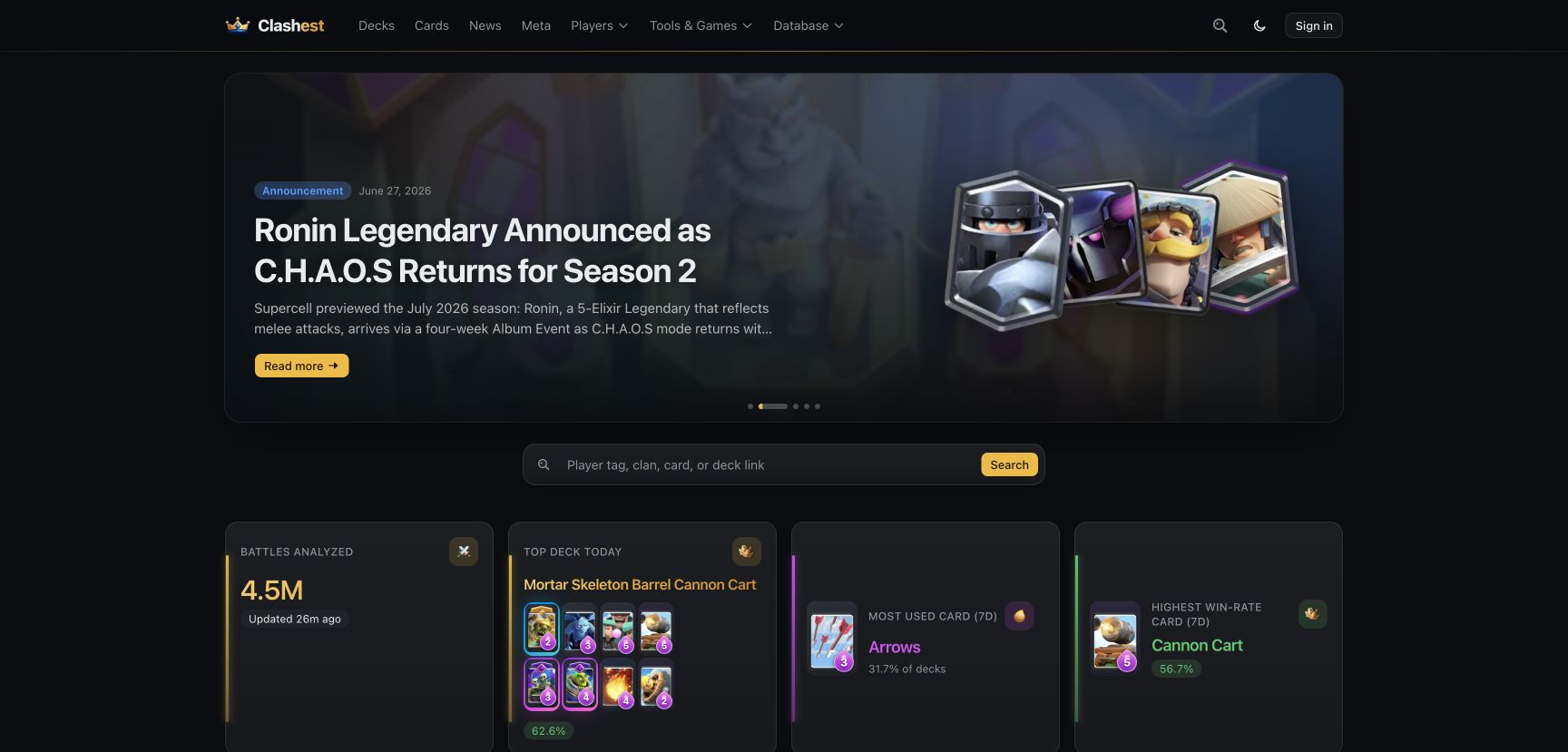
Most game databases begin as reference sites: a list of cards, a few popular decks, and some patch notes. We wanted to build something more useful—a product that could answer the question a Clash Royale player actually has in the moment, whether that is “What is winning today?”, “How is my deck performing?”, or “What should I play in this arena?”
That product became Clashest, a Clash Royale stats and deck database. It brings live meta analysis, deck discovery, card data, player and clan profiles, leaderboards, and practical tools into one fast, searchable platform.
This is a look at why we built Clashest, what it can do, and the product and data decisions that turned a large collection of game information into something players can use.
The problem: game data is plentiful, but answers are hard to find
Clash Royale changes constantly. Balance updates move cards in and out of the meta. New modes create different winning strategies. A deck that performs well on Trophy Road may be a poor choice in Ranked or a limited-time event. Raw usage percentages alone do not tell that story.
Players usually have to piece together an answer from several places: one site for a player profile, another for decks, social posts for balance changes, and videos for strategy. Even then, the data may be old or stripped of the context that makes it meaningful.
We shaped Clashest around three principles:
- Freshness should be visible. A player should know when the data was updated and which time window it covers.
- Every statistic needs context. Win rate means little without usage, sample size, game mode, and trend direction.
- Exploration should lead to action. Finding a deck should make it easy to inspect it, compare it, or copy it into the game.
The result is not just a static database. It is a connected product built around live questions.
A live view of the Clash Royale meta
The core of the platform is the Clash Royale meta dashboard. It organizes millions of analyzed battles into rolling views that players can filter by time period and game mode.
Instead of declaring one universal “best” deck, Clashest exposes the evidence behind a ranking:
- Win rate and usage rate
- Number of battles in the sample
- Average elixir and cycle length
- Relevant game mode
- Recent movement in the meta
- Card and archetype performance
That distinction matters. A deck with an exceptional win rate across a tiny sample should not automatically outrank a consistently strong deck played thousands of times. The interface keeps the supporting numbers close to the recommendation so users can judge the result for themselves.
The meta view also surfaces card tier lists, archetype distribution, rising and falling decks, popular cards that are underperforming, and lower-usage cards that may be quietly strong. It is designed for both quick answers and deeper analysis.
Deck discovery built around how people actually play
There is no single list of the best Clash Royale decks for every player. Available cards, arena, trophy range, preferred archetype, and current mode all change what “best” means.
Clashest therefore treats deck discovery as a set of paths rather than one leaderboard. Players can explore trending decks, pro player decks, top choices for a specific arena, or decks associated with a game mode. Each deck provides the cards, tower troop, elixir profile, cycle information, win rate, usage, battle sample, and a direct copy action.
We also built a Clash Royale deck builder for players who want to start with their own idea. Live elixir math and deck analysis provide feedback while the deck is assembled, closing the gap between browsing data and making a decision.
Player, clan, and competitive profiles
Deck data becomes more useful when it connects back to real players. Clashest’s player search and profile tools use player tags to surface trophies, the current deck, recent battle history, win rate, card levels, and other profile information.
The platform also includes:
- Clan profiles with member, donation, activity, and war information
- Global leaderboards
- Pro player profiles and their decks
- Creator profiles
- Tournament discovery and results
These surfaces share a common search experience, so a player can move from a global trend to a specific deck or competitor without learning a different interface each time.
More than decks: a connected Clash Royale database
A useful game database has to handle both structured facts and changing competitive data. Clashest includes dedicated reference pages for cards, arenas, evolutions, tower troops, chests, emotes, items, game modes, and common game terminology.
The card experience combines stable details—rarity, elixir cost, descriptions, and relationships—with current usage and win-rate signals. That makes a card page useful to a new player learning what a card does and to an experienced player checking how it performs after a balance update.
Guides add the explanatory layer that database fields cannot provide. Players can learn about ranked leagues, deck archetypes, events and challenges, card rarities, star levels, and core game mechanics. News coverage keeps balance changes, updates, and official announcements connected to the affected cards and strategies.
Turning battle records into trustworthy product decisions
The difficult part of a live stats product is not displaying a percentage. It is building a pipeline and interface that make the percentage responsible to use.
Battle data must be collected, normalized, grouped into meaningful windows, and refreshed without making the site feel unstable. Modes need to remain distinct. Duplicate or incomplete records need to be handled consistently. Rankings must account for the tension between performance and sample size. When the underlying population changes, the product needs to communicate that clearly.
We designed the experience so that freshness, battle count, mode, and time window appear alongside the result. Minimum sample thresholds protect card comparisons from the noisiest outliers. Filters let users separate broad popularity from competitive performance. This is as much a product-design problem as a data-engineering problem: good methodology loses its value if the interface hides it.
Search architecture for a large, growing product
Clashest contains several different kinds of entities—players, clans, cards, decks, tournaments, guides, and news. A conventional navigation menu alone would make the product feel like a maze.
We paired clear topical sections with global search and tightly related internal links. A card can lead to decks that use it. A pro profile can lead to a current deck. An arena can lead to decks drawn from its trophy band. A balance update can lead readers back to the cards and meta views needed to understand its effect.
This architecture also gives search engines clear, crawlable relationships between topics. Each important intent has a focused page rather than being buried inside a client-rendered dashboard. Descriptive headings, stable URLs, useful copy, and server-rendered content help the same pages serve people and search crawlers without compromising either experience.
Designing a fast interface for dense information
Stats products can become visually exhausting. Clashest has to display card art, deck compositions, filters, ranks, percentages, and trends—often in the same viewport.
The visual system uses compact cards, strong type hierarchy, consistent stat labels, and color as a supporting signal rather than the only signal. Repeated deck and card patterns reduce the amount a returning user has to relearn. Mobile layouts preserve the most important decision-making data instead of simply shrinking a desktop table.
Performance was part of the interface design from the beginning. The page structure prioritizes the information needed for the first decision while allowing richer sections to follow. That matters for users arriving from search, where a slow or shifting page can erase the value of even the best data.
Tools that make the database useful between matches
Alongside the main database, Clashest includes focused tools and small games:
- An upgrade calculator for planning resources
- Side-by-side card comparison
- Deck building and analysis
- Clashdle and Guess the Card
- Search across players, clans, cards, decks, and tournaments
These are intentionally connected to the same underlying information architecture. The product feels like one system, not a collection of disconnected microsites.
What we learned building Clashest
The biggest lesson was that more data does not automatically create a better product. The useful work is choosing the context, comparisons, and next actions that turn data into a decision.
For Clashest, that meant showing sample sizes instead of presenting rankings as certainty. It meant separating modes rather than blending incompatible battles. It meant connecting reference content to live performance and making discovery flow naturally into deck building or player research.
It also reinforced a principle we use across custom software projects: the data model, information architecture, interface, and acquisition strategy cannot be designed in isolation. Each one shapes the others. When they are developed as a single system, the result can be both technically deep and immediately understandable.
Explore Clashest
Clashest is live and continues to evolve as the game, the meta, and the needs of the community change. You can use it to research cards, find current decks, check a player or clan, follow competitive rankings, read update coverage, or build a deck of your own.
Explore Clashest and the latest Clash Royale stats.
Clashest is an unofficial fan resource and is not endorsed by Supercell. Clash Royale and Supercell are trademarks of Supercell Oy.