Building Pokémonism: One Database for Every Pokémon Game
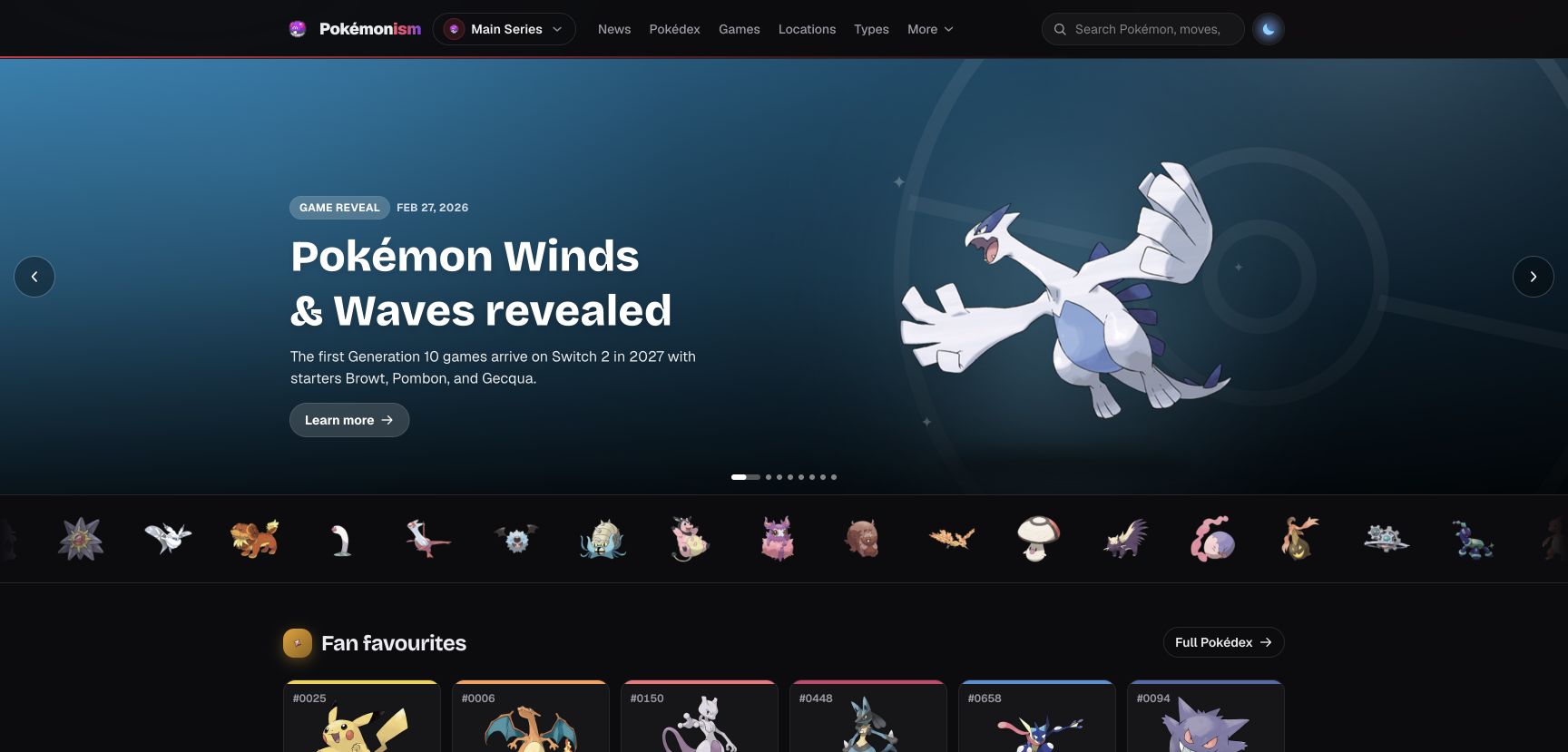
Pokémon has grown far beyond a single series of role-playing games. A player might be checking a main-series evolution in the morning, planning a Pokémon GO raid at lunch, comparing TCG Pocket cards in the afternoon, and researching a competitive Pokémon Champions roster that evening. Each game shares familiar creatures and concepts, but each also has its own rules, data, terminology, release cadence, and community.
That fragmentation was the starting point for Pokémonism, a Pokémon database for every game. We built it as one connected reference for the National Pokédex, the main series, Pokémon GO, Pokémon TCG Pocket, Pokémon Champions, Pokémon Pokopia, current events, tools, news, and creator coverage.
The product challenge was not simply collecting more information. It was deciding how thousands of related records could feel like one understandable system while still respecting the differences between each game.
Species, types, moves, abilities, evolutions, games, and regions.
Main series, GO, TCG Pocket, Champions, and Pokopia.
Time-aware events, announcements, news, and creator discovery.
Type matchups, team building, collection research, and game guides.
The problem: one franchise, many different data models
A conventional Pokédex can organize Pokémon by National Pokédex number and expose familiar details such as types, abilities, base stats, evolutions, and learnsets. That model works well until the product expands into games that interpret Pokémon differently.
Pokémon GO centers combat power, move sets, raids, events, and league-specific usefulness. TCG Pocket revolves around cards, sets, packs, rarity, and deck construction. Champions has a competitive roster, regulations, formats, and battle mechanics. Pokopia is structured around locations, materials, crafting, characters, and the rhythms of a life-simulation game.
Flattening all of those concepts into one generic database would make every section less useful. Splitting them into unrelated websites would make discovery harder and duplicate the shared foundation.
We designed Pokémonism around a third approach: a shared identity layer for the franchise, with dedicated editions for the rules and content unique to each game.
| Edition | Primary information model | The player question |
|---|---|---|
| Main series | Species, stats, moves, games, and locations | How does this Pokémon work here? |
| Pokémon GO | CP, move sets, raids, rankings, and events | What matters right now? |
| TCG Pocket | Cards, sets, packs, and rarity | Where does this card belong? |
| Champions | Roster, formats, Megas, and regulations | What can I bring into battle? |
| Pokopia | World, materials, crafting, and progression | What should I do or find next? |
A National Pokédex as the shared foundation
The full National Pokédex is the center of the main-series experience. It provides a consistent place to browse Pokémon by number, generation, type, and other useful attributes.
Individual records bring together the information players usually need to find across several pages:
- Types and type relationships
- Base stats
- Abilities
- Evolution families and requirements
- Level-up and machine learnsets
- Move coverage
- Game and regional availability
That shared Pokémon identity makes the rest of the platform easier to navigate. A player can begin with a familiar species and then move into the mechanics, games, moves, locations, or specialized editions connected to it.
The database extends beyond Pokémon records. Dedicated sections cover moves, abilities, items, berries, natures, egg groups, TMs and HMs, locations, regional Pokédexes, and the complete 18-type system. An interactive type chart helps answer offensive and defensive matchup questions without requiring users to translate a static grid.
Organizing thirty years of main-series games
The Pokémon games database spans the main series from the earliest Kanto releases through later regions and generations. Each game belongs to a wider chronology, but players often arrive with a much narrower question: which Pokémon are available, where something can be found, which mechanics changed, or how a particular generation differs from the one before it.
We built the game architecture to support both kinds of exploration. A chronological view explains how the series developed from generation to generation, while game, region, Pokédex, and location pages provide focused paths into specific titles.
This structure also gives new releases a natural home. Upcoming and recently launched games can be introduced through the same navigational system without displacing the reference material players still use for older generations.
Pokémon GO needs a live-event layer
Static reference data is only part of the value in Pokémonism’s Pokémon GO section. GO changes through seasons, raids, research, limited-time bonuses, Battle League rotations, and frequent events. A useful database has to show not only what a Pokémon is, but what matters right now.
The GO edition brings together game-specific stats, combat power, move sets, rankings, and tier-oriented information with a live Pokémon GO events calendar. Event pages can connect dates and bonuses to the Pokémon, raids, and game systems they affect.
This required a different content model from the main-series Pokédex. Time becomes a primary field. Events need start and end dates, status, bonuses, featured encounters, and relationships to other records. The interface must make “live now,” “upcoming,” and historical information immediately distinguishable.
The result lets a player move between evergreen research and time-sensitive planning without leaving the same product.
A card-first experience for Pokémon TCG Pocket
Pokémon TCG Pocket shares the franchise’s creatures and types, but its core unit is the card. The TCG Pocket database therefore has its own hierarchy for cards, sets, expansions, and packs.
Players can explore the collection through the language they actually use in the game: which expansion a card belongs to, where it can be obtained, how rare it is, and how it fits alongside other cards. This creates a more useful experience than attaching a small card section to a standard Pokédex entry.
The important architectural decision was to preserve relationships without confusing identities. A Pikachu card is related to Pikachu, but it is not the same database object as the main-series Pokémon record or the Pokémon GO version. Treating those as connected but distinct records keeps the data accurate and gives each page a clear search purpose.
Competitive research for Pokémon Champions
The Pokémon Champions section is built around competitive battling. It covers the available roster, Mega Evolutions, formats, regulations, and the information players need when evaluating a team or preparing for a ruleset.
Competitive players think in combinations: type coverage, roles, moves, abilities, stats, and format restrictions. That makes cross-linking especially valuable. A roster entry should lead naturally to the broader species record, relevant moves, abilities, and type matchups without forcing the user to repeat a search.
Pokémonism also includes a Pokémon team builder for turning research into a practical lineup. Tools like this close the loop between looking up information and using it to make a decision.
Building a useful guide layer for Pokémon Pokopia
Pokémon Pokopia presents a different information problem again. Instead of competitive stats or card collections, players need help with the world itself: locations, progression, materials, crafting, characters, activities, and changing events.
The Pokémon Pokopia guide gives this information a dedicated home while retaining connections to the Pokémon and wider franchise concepts players already recognize. Its content model can grow with updates rather than forcing guide material into fields designed for turn-based battles.
This flexibility was a core requirement for the platform. A multi-game database should be able to add a genuinely different Pokémon experience without redesigning its entire foundation every time the franchise explores a new genre.
Search and navigation across different player intents
The most technically complete database can still fail if people cannot find the right edition. A search for a Pokémon name might reasonably refer to its main-series stats, its GO performance, or one of many TCG Pocket cards.
Pokémonism uses edition-aware navigation to keep that context visible. The main navigation establishes the active game while global search and shared visual patterns help users move across the wider database. Each edition can prioritize its own tasks without feeling like a separate brand.
We paired that navigation with a deeply linked information architecture:
- Pokémon connect to types, abilities, moves, evolutions, games, and regions.
- Moves connect back to every Pokémon that can learn them.
- Games connect to regional Pokédexes and locations.
- Live events connect to the encounters and mechanics they affect.
- Cards connect to sets, packs, and their underlying Pokémon identity.
Those relationships help people browse naturally, but they also create clear, crawlable paths for search engines. Important search intents have focused pages with descriptive titles, headings, and stable URLs rather than being hidden inside a single client-side search interface.
Combining structured data with current coverage
A database answers questions that have stable facts. A living franchise also produces announcements, updates, events, strategies, and community discussion every day.
Pokémonism combines its structured reference layer with current news and a creator feed spanning the main series, competitive play, Pokémon GO, the TCG, and Pokopia. This helps users understand not only the underlying mechanic, but why a topic matters at a particular moment.
Keeping those layers connected is important. News should lead into the relevant database or game section. Reference pages should provide a path to current developments without becoming cluttered timelines. Creator discovery should add perspective while keeping source and category visible.
Designing dense information without losing personality
Pokémon data can become visually overwhelming: hundreds of species, long learnsets, large card collections, generations of games, and schedules full of events.
The interface uses a dark visual system, edition-specific accents, recognizable imagery, strong headings, compact data cards, and repeated interaction patterns. The goal is to make dense pages scannable while retaining the energy and personality people expect from a fan-made Pokémon product.
Responsive behavior matters just as much as the desktop layout. Many event checks, type lookups, and collection questions happen on a phone while someone is playing. Tables and dense record layouts must preserve their most important information without becoming miniature desktop pages.
What we learned building Pokémonism
The central lesson was that “all in one place” only works when the product preserves context. Combining databases is easy. Combining them without erasing the differences that make each game useful is the real design and engineering work.
Pokémonism needed a shared vocabulary for Pokémon, moves, types, games, and relationships, alongside edition-specific models for combat power, cards, regulations, events, and crafting. It needed navigation that made those boundaries clear and search architecture that still allowed the entire platform to feel connected.
That approach reflects how we think about custom software platforms: the data model, product structure, interface, content strategy, and search strategy have to be designed as one system. When those decisions reinforce one another, a large database can remain understandable even as its scope expands.
Explore Pokémonism
Pokémonism is live and continuing to grow with the franchise. Players can use it to browse the National Pokédex, research a main-series game, follow Pokémon GO events, explore TCG Pocket cards, prepare for Pokémon Champions, learn the systems in Pokopia, or discover current news and community creators.
Pokémonism is an unofficial, fan-made resource and is not endorsed by Nintendo, Game Freak, or The Pokémon Company. Pokémon and Pokémon character names are trademarks of their respective owners.