Brawl Stars is easy to start and difficult to reduce to a single ranking. A brawler can dominate one mode and struggle in another. A strong build can change with the map, team composition, or balance patch. Even a convincing win rate can be misleading when it comes from too few matches.
Those moving parts were the starting point for Brawlest, a Brawl Stars database and stats platform. We built it to connect live meta analysis with the reference information players need before choosing a brawler: current maps, game modes, builds, matchups, trophy ranges, player profiles, skins, balance history, and update coverage.
The goal was not to publish another static list of characters. It was to build a living product that could answer a more useful question: what should I know before my next match?
Adjusted win rate, pick rate, matches, players, modes, trophy ranges, and trends.
Stats, abilities, builds, matchups, maps, skins, guides, and balance history.
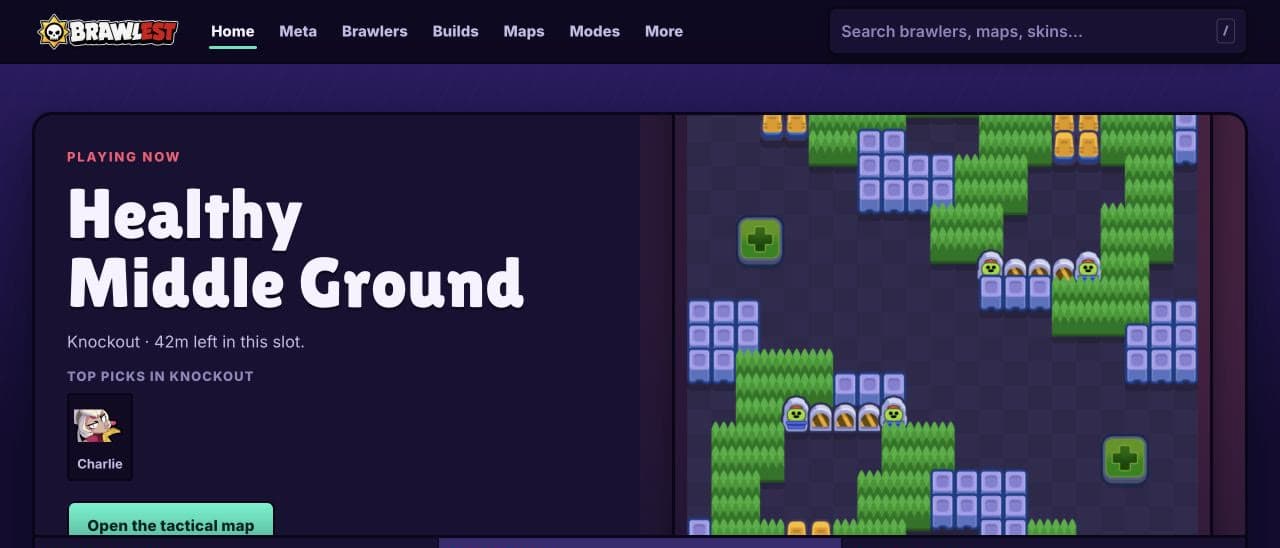
Current and upcoming maps organized by mode, slot, and time remaining.
Published sources, sample thresholds, collection limits, and update times.
The problem: “best” changes with the match
A general Brawl Stars tier list is useful as an overview, but it cannot explain every decision. The best brawler for an open Bounty map may be a poor fit for a tight Brawl Ball layout. Trophy range changes the players and loadouts represented in the sample. A newly released brawler can appear unusually strong or weak while the player base is still learning how to use and counter it.
Most players therefore move between several disconnected sources. They check one list for the current meta, watch a video for a build, search for the live map rotation, and open patch notes to find out whether the advice is still current. The facts may all be available, but the relationship between them is missing.
We designed Brawlest around three product principles:
- Context belongs beside the ranking. Every performance number should identify its window, sample, mode, and relevant filters.
- Live data and reviewed guidance are different things. Measured results should not be presented as editorial opinion, and recommendations should not pretend to be API data.
- Every page should lead to the next useful decision. A brawler can lead to a build, a build to a mode, a mode to a live map, and a map back to the strongest available picks.
A Brawl Stars meta board that keeps the sample visible
The Brawl Stars meta rankings are the analytical center of the platform. Players can browse the strongest brawlers overall or narrow the board by game mode and trophy range. Each ranked row keeps the adjusted win rate, pick rate, match count, player count, strongest mode, and recent direction close to the brawler’s position.
That supporting evidence matters. A high percentage drawn from a small or unusual group of matches should not be treated like the same percentage supported by thousands of results. Brawlest uses minimum publication thresholds, adjusts thin samples toward the overall field, and calculates confidence intervals before a brawler receives a ranked recommendation.
The Brawl Stars tier list turns the same underlying analysis into familiar S-through-D groups. Tier boundaries are fixed and applied consistently rather than moving brawlers by hand. Players who want a quick answer get one, while those who want to audit it can move directly into the complete board or methodology.
| Question | Brawlest surface | Context kept with the answer |
|---|---|---|
| Who is strongest right now? | Meta rankings | Win rate, pick rate, matches, players, and trend |
| Where does every brawler stand? | Tier list | Fixed tier thresholds and publication requirements |
| Who works in this mode? | Mode view | Live maps, rules, picks, and mode-specific results |
| Who works at my level? | Trophy-range filter | The brawler trophies recorded when each match was played |
| Can I trust the number? | Methodology | Sources, calculations, thresholds, windows, and limits |
One brawler page connects facts, performance, and play
The complete Brawl Stars brawler database supports search, filtering, and sorting across the roster. Players can narrow characters by class, rarity, strongest mode, rank, trend, or pick rate instead of scanning one long alphabetical list.
Each brawler then receives a detailed destination that combines several kinds of information:
- Base statistics at different power levels
- Attack and Super range, damage, reload, projectiles, and charge behavior
- Gadgets, Star Powers, Gears, and Hypercharges
- Current rank, adjusted win rate, pick rate, matches, and recent movement
- Performance by trophy range and game mode
- Best and worst maps
- Favorable matchups, difficult opponents, and effective teammates
- Reviewed build recommendations for different situations
- Practical positioning, ability use, mode advice, and common mistakes
- Skins, emotes, and recorded balance changes
This structure makes a brawler page valuable to different kinds of visitors. A new player can learn what an ability does. A returning player can check what changed. A competitive player can compare mode performance and matchups. Someone arriving from search for a specific build can see the live results that frame the recommendation.
The important design decision was to avoid splitting those needs into isolated mini-sites. Stable game facts, changing analytics, and reviewed strategy remain visibly distinct, but they share one navigational system.
Reviewed builds without invented performance claims
Choosing a brawler is only half the decision. Players also need to know which Gadget, Star Power, Gears, and Hypercharge make sense together.
The Brawl Stars builds database provides reviewed loadouts for the full roster. A build is more than a row of icons: it identifies the situation it is intended for and explains why each component belongs there. Where a brawler supports different play styles, the page can recommend separate loadouts for aggressive play, survival, objective control, or a specific mode.
There is an important data boundary here. The official battle log does not report the Gadget, Star Power, or Gears equipped during a match. That means Brawlest cannot responsibly claim a measured win rate for an individual loadout.
Instead, builds are labeled as editorial recommendations and carry a review date. Live brawler performance remains measured data. The build remains reviewed guidance. Preserving that distinction is more trustworthy than manufacturing precision from information the source does not provide.
Live maps and modes turn rankings into tactical choices
Brawl Stars rotates maps throughout the day, so a database that ignores the current event schedule misses one of the game’s most useful signals.
The Brawl Stars maps and rotation tracker separates maps playing now from completed and upcoming slots. Each live entry identifies the mode and the time remaining. Map pages connect the layout and rotation status to brawler performance, helping players move from “What is active?” to “What should I play here?” without beginning another search.
The modes directory explains what each format asks of a team, which maps are live in it, and which brawlers are producing credible results. This is especially useful because the strategic value of range, mobility, wall breaking, area control, and survivability changes dramatically between modes.
The information graph works in both directions:
- A live map leads to the mode and strongest picks.
- A mode leads to its active maps and brawler rankings.
- A brawler leads to its best modes and maps.
- A build explains when to switch parts of the loadout for a different objective.
That connected flow is what turns a catalogue into a decision tool.
Player leaderboards and profiles without an invented rating
Brawlest also follows the competitive edge of the game through its Brawl Stars player leaderboard. The board shows trophy leaders among the accounts the platform has read, along with current totals, observed trophy movement, recent brawler choices, and battle counts.
Player pages use the account tag to organize the public profile and recent battle information returned by the official API. The platform does not create a hidden skill score, grade, or percentile. Brawl Stars supplies trophies as the public account score, so that is what the leaderboard uses.
The coverage limit is stated plainly: Brawlest begins with ranked players and expands through opponents and teammates found in battle logs. It is a growing observed network, not a census of every account. Making that scope visible prevents a useful leaderboard from becoming a larger claim than the data can support.
Building a responsible analytics pipeline
Displaying a percentage is straightforward. Producing a percentage that deserves to influence a player’s choice is the difficult part.
Brawlest reads the official Brawl Stars API on a recurring schedule. Collection begins with ranked players and expands through the participants found in their recent battles. Because the same match can appear in several player logs, each battle is stored once using a fingerprint derived from the match. This protects aggregate results from duplicate observations.
From there, the pipeline creates several views over the same recorded battles: overall results, modes, maps, trophy ranges, and comparable seven-day windows. Showdown is excluded from conventional win-rate calculations because its placement result is not equivalent to the win/loss outcome used by team modes.
The platform also has to handle ambiguity rather than erase it. A map identity is stored when the battle is first recorded because event identifiers can later be reused. Draws are counted but excluded from the decided-match win-rate denominator. Low-volume pairings and recommendations stay unpublished until they clear evidence requirements. When a map lacks enough data, a broader mode result can appear only when it is clearly labeled as such.
The full Brawlest methodology documents those decisions, including collection sources, adjusted win rate, pick rate, trophy ranges, trends, publication thresholds, update frequency, and known limits.
Updates, skins, and reference data around the live layer
Performance data changes because the game changes. New brawlers arrive, balance adjustments alter matchups, maps rotate, abilities are reworked, and cosmetics expand the catalogue.
Brawlest keeps those changes connected to the affected records. The updates section organizes release notes and patch coverage, while brawler pages preserve a balance-history view. This gives someone reading an older recommendation a direct path to the changes that may have altered it.
The Brawl Stars skins database adds the collection layer, with search and filters for brawler, collection, rarity, acquisition method, and listed gem price where available. Skin data is treated as sourced catalogue information rather than a live store feed, and the methodology explains that limitation.
Guides and selected community videos add an explanatory layer around the structured records. The product can answer a factual question quickly, then provide a deeper route for a player who wants strategy, update context, or creator analysis.
Search architecture for a database that changes every day
Brawlest contains several distinct entity types: brawlers, builds, maps, modes, skins, players, updates, guides, and rankings. A single client-side dashboard would make much of that information difficult to discover and harder to revisit.
We gave the major search intents stable, descriptive pages and linked them through real product relationships. Global search helps visitors reach a known brawler, map, or skin quickly. Directory pages support broader browsing. Detailed pages expose focused headings and crawlable information, while breadcrumbs and contextual links make the hierarchy clear to both people and search engines.
This architecture supports search visibility without creating pages merely to capture a keyword. A brawler page has a durable purpose because it connects reference data to current performance. A map page is useful because its rotation and best picks change. A build page earns its own route because its recommendations and reasoning differ from the general stats page.
The result is an SEO system built on product utility: every indexable page answers a specific Brawl Stars question and points to the next relevant answer.
Designing dense game data for quick decisions
A Brawl Stars stats site has to show many visual and numeric signals at once: character art, ranks, percentages, sample sizes, movement, map layouts, ability icons, filters, and update times. If every signal competes for attention, the fastest path to an answer disappears.
Brawlest uses a compact interface, consistent metric patterns, clear filter states, and repeated card structures across the roster. The most decision-relevant information appears early, while deeper evidence and reference sections remain available below. On mobile, layouts prioritize the identity, ranking, and current context instead of squeezing a desktop analytics table onto a narrow screen.
Freshness is part of that interface. Pages state when analytics were recomputed or editorial guidance was reviewed. A changing number without a visible timestamp is difficult to trust, no matter how accurate the pipeline behind it may be.
What we learned building Brawlest
The central lesson was that a trustworthy recommendation needs both evidence and restraint.
Evidence means keeping the match count, player count, time window, mode, and trophy range close to the result. Restraint means leaving a row unranked when the sample is too thin, refusing to invent build win rates the API cannot support, and documenting which players and battles the collection process can see.
Brawlest also reinforced the value of designing editorial content and live data together. Builds and play guides become more useful when they sit beside current mode performance. Patch notes become more useful when they lead back to affected brawlers. A map rotation becomes more useful when it connects directly to credible picks.
That is the same principle we bring to custom software and data-platform development: collection, methodology, content modeling, interface design, performance, and organic discovery should be treated as one product system. When those layers support one another, a large database can still deliver a fast, clear answer.
Explore Brawlest
Brawlest is live and continues to change alongside the Brawl Stars roster, meta, maps, and release cycle. Players can use it to compare brawlers, check the current tier list, choose a reviewed build, see what is in rotation, research a matchup, follow player rankings, browse skins, or understand exactly how the numbers were produced.
Brawlest is an independent fan-created resource and is not affiliated with, endorsed, sponsored, or specifically approved by Supercell. Brawl Stars and related game content are trademarks and copyrights of Supercell Oy.