Warhammer is not one setting, one game, or one kind of hobby. It is a collection of universes filled with armies, characters, worlds, battles, books, miniatures, rules, painting projects, and decades of lore. Someone arriving for the first time may need help choosing a faction. A reader may be trying to place a character in the timeline. A player may want to test an attack profile, while a painter may simply need the closest equivalent to a Citadel colour.
Those questions often send people in completely different directions: old wiki pages for lore, store listings for miniatures, community threads for reading orders, spreadsheets for army planning, and separate calculators for tabletop probability.
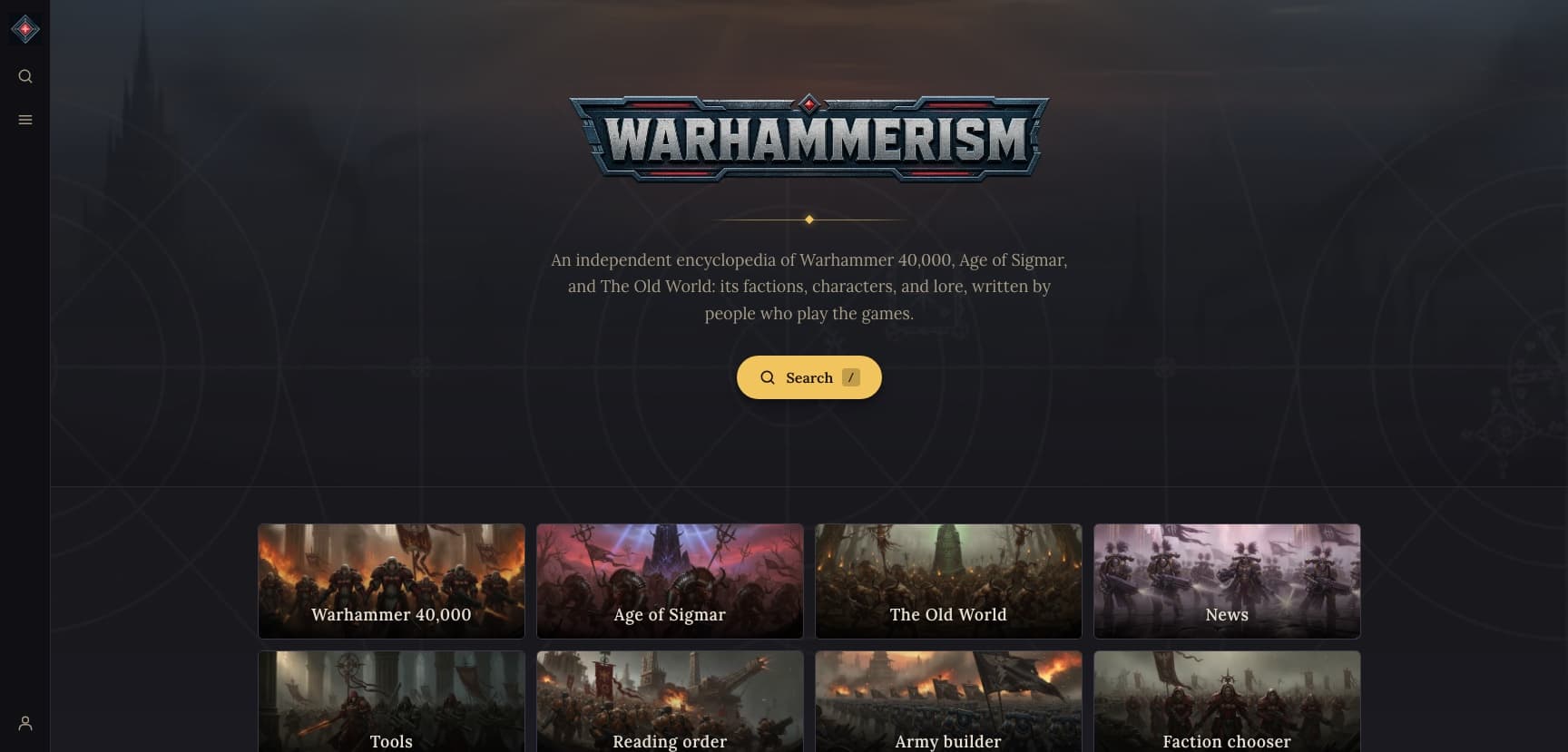
That fragmentation became the starting point for Warhammerism, a Warhammer encyclopedia for factions, lore, and hobby tools. We built it as an independent, cross-linked reference for Warhammer 40,000, Age of Sigmar, and The Old World, with practical tools that carry research into collecting, painting, reading, and play.
The challenge was not merely publishing a large number of pages. Warhammerism needed an information architecture broad enough to connect three settings and eighteen kinds of encyclopedia entry without flattening their differences. It also needed clear editorial boundaries: original summaries rather than copied wiki text, no reproduced datasheets, visible verification states, reviewed community contributions, and an explicit distinction between reference knowledge, current news, and hobby opinion.
Factions, subfactions, units, characters, worlds, battles, books, lore, glossary terms, and more.
Warhammer 40,000, Age of Sigmar, and The Old World retain their own language, hierarchy, and visual identity.
Faction matching, army lists, exact dice math, colour planning, paint conversion, kit discovery, and reading paths.
Categories, citations, page history, related changes, corrections, moderated edits, discussions, and watchlists.
The problem: a large fandom creates a navigation problem
Warhammer information is plentiful, but finding the right starting point is difficult. A newcomer searching for Warhammer 40,000 factions may not know whether a Chapter is a faction, a subfaction, or a historical Legion. Someone entering Age of Sigmar may understand the four Grand Alliances but not how they relate to individual armies. A returning Warhammer Fantasy player may need a clear path into The Old World without mixing the new game with every prior edition.
The same ambiguity appears inside the lore. A world can belong to a region, host a battle, produce a character, and connect to several factions. A named weapon can be both a relic and part of a character's story. A book belongs in a reading path but also supplies context for factions, eras, and events.
A conventional blog cannot hold those relationships well. A flat wiki can hold them, but it often gives readers an alphabetical archive without helping them decide where to go next.
We shaped Warhammerism around a different principle: every page should answer one question clearly, reveal where that answer sits in the wider setting, and offer the next useful path.
| Product layer | The immediate question | What the platform keeps connected |
|---|---|---|
| Universe hubs | Which setting am I exploring? | Factions, lore, timeline, atlas, books, games, and setting-specific tools |
| Encyclopedia | What is this person, place, army, or object? | Parent faction, related entries, categories, sources, history, and navigation |
| Hobby tools | What should I choose, build, roll, or paint? | Structured reference data, shareable state, assumptions, and practical next steps |
| Editorial | What changed recently? | Original reporting, primary sources, wider hobby headlines, and releases |
| Community | How can this page improve? | Moderated edits, discussions, revisions, corrections, and watchlists |
One Warhammer encyclopedia, three distinct universes
The Warhammer universes hub separates the archive into three primary gateways.
The Warhammer 40,000 encyclopedia covers the far-future setting, including the Imperium, Chaos, Xenos civilizations, and the Horus Heresy. The Age of Sigmar database organizes the Mortal Realms around the Grand Alliances of Order, Chaos, Death, and Destruction. The Warhammer: The Old World archive returns to rank-and-file fantasy armies, kingdoms, regions, and the history surrounding the World of Legend.
Each universe receives its own hub, factions, terminology, places, chronology, and visual atmosphere. Underneath, however, they share a consistent product model. A reader who learns how to move from an Age of Sigmar faction to its units, characters, lore, and books can follow the same pattern in The Old World without the settings becoming interchangeable.
This shared structure is what makes cross-universe tools possible. An army builder can support all three systems. A paint workflow can begin with a 40K trooper, an Age of Sigmar hero, or an Old World soldier. Search can span the entire archive while still keeping every result attached to the correct setting.
Modeling eighteen kinds of Warhammer knowledge
At the time of this case study, Warhammerism contains 3,652 published encyclopedia entries across eighteen structured entity types. That includes 92 factions, 336 subfactions, 1,324 units, 442 characters, and 558 glossary terms, alongside worlds, battles, weapons, organizations, deities, species, relics, regions, eras, vessels, books, games, and original lore articles.
Those are not simply tags on generic posts. Each type carries relationships that match the subject.
- A faction can contain subfactions, units, characters, related books, and a complete roster navigation box.
- A unit belongs to an army and may connect to a product mapping, battlefield role, weapons, and related characters.
- A world can sit inside a region, appear in a battle, and connect to the factions that fought there.
- A book can belong to a series and a curated reading path without being treated like a lore article.
- A glossary term can explain an unfamiliar concept quickly, then send the reader into the full entries behind it.
The schema gives every page a stable canonical route and makes those relationships available to search, category pages, navigation, sitemaps, and contextual links. It also lets the product grow without turning every new topic into an isolated article.
Discovery beyond a single search box
Global search is essential for a reference product, but search assumes the visitor already knows the right words. Warhammerism supports several complementary ways to explore.
The Warhammer A–Z index provides an exhaustive alphabetical route across the archive. Universe and section listings organize entries by what they are. Derived category pages gather complete rosters and relationships, such as every unit attached to a faction or every entry associated with a broader alignment. Hover previews provide a quick summary without forcing a full page change.
For geographic and historical questions, each universe also has an atlas and a timeline. The Warhammer 40,000 atlas connects worlds to a visual map of the galaxy, while the Warhammer 40,000 timeline moves from the War in Heaven through the Great Rift and the Era Indomitus.
These paths solve different discovery problems:
- Search answers “Where is the thing I know?”
- Categories answer “What belongs with this?”
- A–Z answers “What does the archive contain?”
- Atlases answer “Where did this happen?”
- Timelines answer “When did this happen?”
- Universe hubs answer “Where should I begin?”
Together they make a large Warhammer lore database usable for both direct lookup and open-ended reading.
Encyclopedia pages with real wiki mechanics
A useful encyclopedia needs more than article text. Warhammerism gives its entries the page furniture readers expect from a mature reference system: breadcrumbs, a contents list that follows the reader, infoboxes, category links, complete sibling navigation, related records, references, and clear last-modified information.
Each page also includes Read, Edit, Discussion, and History views. Page tools expose a permanent link, citation details, printable output, a QR code, page information, and “What links here.” Related changes can show revisions across the records connected to the page.
Members can suggest a full edit or change one section in place. Contributions enter a moderation queue before publication. Approved edits create an append-only revision with an attributable diff, appear in recent changes, and can update the watchlist feed of someone following that page. Comments and uploaded pictures follow their own review paths, and uploaded media requires a description, source, and confirmation of publication rights.
This workflow matters because open contribution and immediate publication are not the same thing. Warhammerism lets a community help improve the archive while keeping editorial review, provenance, and rollback history inside the product.
A faction chooser designed for the first decision
Many people enter the hobby with a broad visual preference but no vocabulary for the available armies. The Warhammer faction chooser asks how someone likes to play, paint, and collect, then narrows the field to a useful shortlist.
It does not pretend there is one objectively best faction. The matching is based on taste: melee or ranged preference, elite or horde armies, painting complexity, and the type of story or visual identity that appeals to the player. Every result leads into the relevant faction, units, and lore, turning a short recommendation into a well-supported research path.
Quizzes and faction tier lists remain separate on purpose. A personality quiz is entertainment. A tier list is an editorial view of the current competitive environment. The chooser is a practical buying and collecting decision. Labeling those intentions prevents three very different products from presenting themselves as the same kind of authority.
Army building without reproducing official rules
The free Warhammer army builder works across Warhammer 40,000, Age of Sigmar, and The Old World. A user selects a faction, adds units from its catalogue, enters points, and tracks the roster against a chosen limit.
The important product boundary is visible inside the tool: it is edition-agnostic and does not reproduce official points or datasheets. Players enter the relevant values themselves. Warhammerism supplies the organized faction and unit catalogue, running totals, model counts, import and export, print output, and a shareable data link. Signed-in members can also save lists for later.
That approach keeps the utility useful across balance changes and editions while respecting the role of official publications. It also demonstrates a broader platform principle: structured reference data can support an action without copying every protected rule that surrounds it.
Mathhammer that shows the whole probability distribution
Average damage is helpful, but it can hide how volatile an attack really is. The Warhammer mathhammer calculator carries the full probability distribution through attacks, hits, wounds, saves, damage, and models slain.
Players can enter fixed or dice-based attack counts, hit and wound thresholds, rerolls, armour penetration, invulnerable saves, damage, wounds per model, and an optional unit size. The result shows expected hits, wounds, unsaved wounds, total damage, and casualties, alongside the chance of slaying exactly or at least a given number of models. Two profiles can be compared side by side, and the complete setup can be shared in the URL.
The calculator uses generic dice inputs rather than official datasheets. Its assumptions are published beside the result: independent rolls, the better available save, no damage spillover between models, and no unmodeled edition-specific special rules. That transparency turns a black-box number into something a player can evaluate.
Painting tools that connect colour choice to a shopping list
Painting is another area where reference information becomes more useful when it leads directly into a workflow.
The Warhammer colour scheme designer lets a hobbyist recolour an original figure from each of the three universes, experiment with armour, trim, cloth, weapons, and details, and receive a practical paint recipe. Schemes can be randomized, saved, shared by link, or exported as an image.
The Citadel paint conversion chart maps 66 common colours to approximate Vallejo and Army Painter equivalents. It also accepts any colour and ranks the nearest Citadel swatches using CIEDE2000 colour distance. Every result stays explicitly approximate because pigment, finish, and coverage cannot be reduced to one hex value.
Saved schemes can flow into Warhammer paint projects, where painters track owned colours and copy a shopping list for what remains. Original step-by-step Warhammer paint guides provide ready-made starting points across all three universes, from battle-ready Ultramarines and spectral Nighthaunt to Old World Bretonnian and Tomb Kings recipes.
The same system supports experimentation, instruction, inventory, and purchasing preparation without pretending there is one official way to paint an army.
Model discovery with verification built into the result
The Warhammer model and kit finder answers a deceptively difficult collecting question: which plastic kit, starter set, or book is connected to this faction or unit?
The index uses editorial mappings rather than an automated claim that every name match is correct. Each relationship is labeled verified, likely, or unverified, with filters for universe, entry type, product type, availability, and status. It does not show prices or direct store links.
That status model is more useful than false completeness. A growing database can expose what is known, what needs confirmation, and what has not been checked yet without giving all three the same visual certainty.
Reading orders that explain how they were ordered
Warhammer fiction is large enough that “start at the beginning” is often not actionable. The Warhammer reading order provides curated paths for newcomers, the Inquisition, Gaunt's Ghosts, Space Marines, Chaos, the Horus Heresy, the Mortal Realms, Stormcast Eternals, The Old World, and Gotrek & Felix.
Every path states who it is for, which books form the core route, which are optional, and how the order was chosen. Readers can mark books as they progress. The page also admits where the archive does not yet have enough book coverage to support a responsible path.
That last detail is important. A reading guide should not manufacture completeness by pointing to entries that do not exist or presenting one subjective sequence as a universal chronology. It should explain the editorial choice and let the reader decide how deep to go.
Current news connected to evergreen reference pages
Warhammer changes through codexes, battletomes, previews, model announcements, video games, balance updates, and community discoveries. Warhammerism combines the encyclopedia with a current Warhammer news hub.
Original reporting appears first and cites the sources behind factual claims. A wider hobby feed sits beneath it with clear publisher attribution rather than being rewritten under the Warhammerism name. The Warhammer release tracker is maintained against official announcements and shows a release date only when the source actually provides one. A smaller codes area tracks active and expired promotional codes for supported games.
This creates a useful relationship between timely and evergreen content. A release announcement can introduce a faction, model, or game; the encyclopedia can then answer the deeper question after the headline is old. Current coverage earns attention today while structured reference pages continue to serve readers over time.
Original artwork, galleries, and downloadable faction wallpapers
Warhammerism uses an original visual library created specifically for the site rather than scraping or hotlinking official artwork. That library gives factions, characters, units, worlds, lore, and other entry types a consistent visual identity across cards, banners, infoboxes, galleries, and social surfaces.
Faction artwork is also available through dedicated Warhammer 40,000 wallpaper downloads, with desktop, high-resolution, and phone formats. The same pattern extends across the other universe galleries.
The media system records intrinsic dimensions so pages can reserve the correct space before an image loads. Different entry types use different aspect ratios, and wide banners use attention-cropped social variants so the subject survives the crop. Those details are easy to overlook, but they are what keep an image-heavy encyclopedia stable and readable on both phones and large displays.
Search architecture for thousands of interconnected pages
Warhammerism's search strategy begins with useful, stable routes. Important information is not hidden inside one client-rendered application. Each universe, section, category, faction, unit, character, world, battle, glossary term, book, article, tool, and reading path has a descriptive URL and server-rendered page.
Breadcrumbs and contextual links make the hierarchy legible. Navboxes expose complete faction rosters in the HTML. Category pages connect broader concepts to their members. Search, A–Z, timelines, atlases, news, and tools provide additional routes into the same graph. Canonical metadata, sitemaps, structured data, social previews, and crawl rules are generated from the same underlying records.
This is the core of the SEO approach: not thousands of disconnected pages targeting near-identical keywords, but a coherent reference graph in which each page has a distinct purpose and meaningful relationships to the rest of the site.
The architecture also keeps private or low-value surfaces out of search. Account pages, admin routes, editing screens, histories, API endpoints, and tracking parameters are excluded where appropriate, while public article pages and media remain crawlable. Good technical SEO includes deciding what should not compete for a crawler's attention.
What we learned building Warhammerism
The central lesson was that an encyclopedia is not primarily a writing project. It is a relationship and trust project.
Warhammerism works because a faction is connected to its subfactions, units, characters, lore, books, products, and hobby actions. A reader can move from “Which army fits me?” to the faction overview, the unit roster, a shareable army list, a paint scheme, and a reading path without leaving the same product.
The platform also reinforced the need to distinguish several kinds of authority:
- Reference knowledge: original, structured explanations of the settings and their entities.
- Editorial judgment: reading paths, tier lists, paint recipes, and recommendations that state their perspective.
- Calculated output: probability distributions and colour distances with visible inputs and assumptions.
- Current reporting: dated news and releases tied back to inspectable sources.
- Community contribution: edits, comments, and media that become public only after review.
Treating those layers differently is what makes it possible to automate search, relationships, sitemaps, and calculations without automating away editorial responsibility.
That is the same systems thinking we bring to custom software platforms: content modeling, information architecture, search, editorial workflow, interactive tools, performance, and acquisition strategy have to reinforce one another. Warhammerism is useful because the encyclopedia does not end at an answer. It leads naturally into the next question or hobby decision.
Explore Warhammerism
Warhammerism is live and continuing to expand across Warhammer 40,000, Age of Sigmar, and The Old World. Readers can research a faction, follow a character through the lore, browse an army roster, study a timeline, explore an atlas, choose a first army, build a list, compare attack probabilities, plan a paint scheme, convert colours, find a kit, follow a reading path, or catch up on recent releases.
Warhammerism is an unofficial fan-made resource and is not affiliated with, endorsed, sponsored, or approved by Games Workshop. Warhammer, Warhammer 40,000, and all associated names, characters, races, and imagery are either ™ and/or © Games Workshop Limited, used without permission. No challenge to their status is intended.